Interpreting the Constitution: How Courts Keep Democracy Breathing.
The judicial branch’s role in keeping both federal and state constitutions responsive to modern realities. We haven’t been getting much of it lately.

How Courts Keep Democracy Breathing
The Constitution doesn’t enforce itself. Its meaning—its power—comes alive through interpretation. That’s the job of the judiciary: to apply foundational principles to new contexts, technologies, and crises. Whether expanding rights or checking abuses, courts are the oxygen that keeps our democracy breathing.
🧠 Why Interpretation Matters
The Constitution is brief: It doesn’t mention privacy, digital surveillance, reproductive autonomy, or corporate personhood.
Society evolves: New challenges demand new applications of old principles.
Text alone isn’t enough: Without interpretation, the Constitution becomes a relic—not a guide.
🗣️ “The Constitution is not an instrument for the government to restrain the people, it is an instrument for the people to restrain the government.”
—Patrick Henry
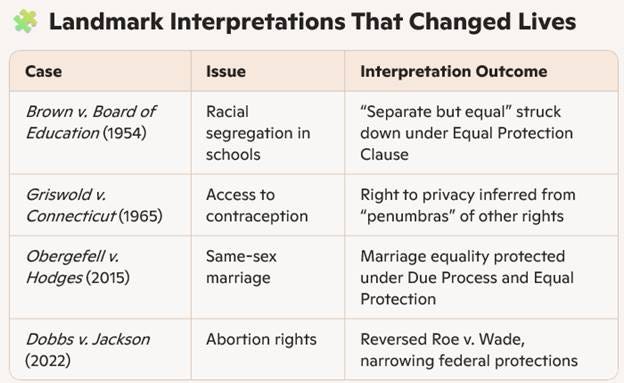
These decisions didn’t rewrite the Constitution—they interpreted it in light of contemporary values and conflicts.
🏛️ State Courts: Guardians of Local Rights
State supreme courts often go further than federal courts in protecting rights:
Montana: Interpreted its constitution to guarantee environmental protections.
New Jersey: Expanded housing rights through judicial mandates.
California: Interpreted privacy and labor protections more broadly than federal standards.
🧠 “The judiciary... is the safeguard of our liberty and of our property under the Constitution.”
—Charles Evans Hughes
🔍 Originalism vs. Living Interpretation
Originalists argue that meaning is fixed at ratification. But living constitutionalists see interpretation as essential to relevance. Courts don’t invent rights—they reveal how enduring principles apply to new realities.
📣 The Takeaway
Judicial interpretation is not judicial activism—it’s democratic maintenance. It’s how we ensure that the Constitution remains a living document, capable of protecting people in a world the framers could never have imagined.